
Originally published by Red Tape Florida. This is an edited version.
By: Gabriel Carraro de Andrade
The United States is experiencing a labor shortage across various sectors, with education and healthcare being hit the hardest. The COVID-19 pandemic has exacerbated the shortage.
With a shift towards remote work, many younger individuals are less inclined to pursue high-stress, low-reward careers in healthcare. At the same time, mass layoffs forced many older professionals into early retirement, leaving critical gaps in the healthcare workforce.
Dentistry reflects the broader healthcare crisis. Many positions vacated by older generations are not being filled quickly enough, and the gaps in services continue to widen, particularly in underserved regions like Florida. Implementing subsidies for skilled immigrants could help solve the pressing healthcare and education crises that the U.S. is facing, ensuring a more sustainable future for essential services.
A Florida Workforce Survey regarding dental care professionals showed that around 70% of dentists work in a general private practice, while only 4% work in a public health practice. The lack of dentists in public health limits accessibility to dental care. Many private practices do not accept Medicaid.
Additionally, recent data from the Health Resources and Services Administration (HRSA) showed that Florida is the worst state in the nation for dental access. Currently, 65 of Florida’s 67 counties are designated, either in full or in part, as dental health professional shortage areas, with population-to-dentist ratios exceeding 5,000 to 1. This has left over 7.1 million Floridians living in “dental deserts.” According to HRSA, an additional 1,536 dentists are needed just to eliminate the current shortages. Lafayette County in the Big Bend has no dentists at all, and there are several other counties where the ratio is as low as one-tenth of the national average. This is a critical issue, as dental health is as important as general health care.

With an aging population and declining interest in healthcare professions among younger generations, the dental care shortage is worsening. The same Workforce survey also found that a mere 4.7% of dentists are 20-29 years old and the extensive process of becoming licensed as a dentist in the United States is scaring university students away. On average, it takes students 6-8 years to be able to practice in Florida as a dentist from the beginning of undergraduate studies (not including any specialization licenses). Increases in costs of living due to post-COVID inflation have caused many to avoid taking out massive loans needed to afford dental school, since these costs can range between $100,000 to even a whopping $400,000. This survey fails to show the impact of the COVID-19 pandemic, as it was conducted from 2019 to 2020 and published in 2023; however, it still shows the effects of barriers of entry for the younger population.
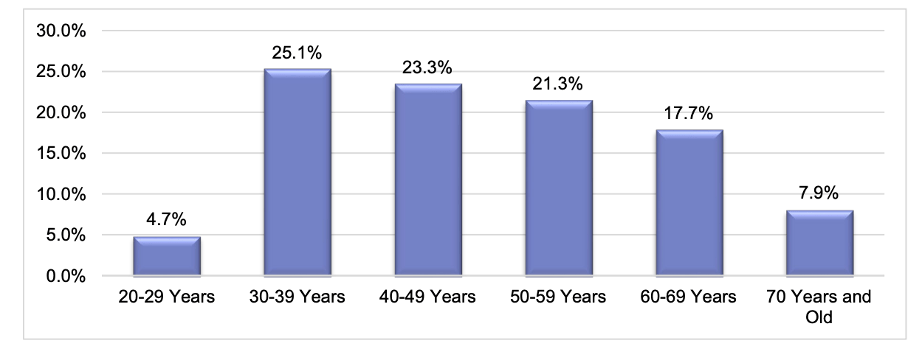
Source: data.hrsa.gov
The extensive requirements for becoming a dental hygienist highlight the need for more accessible licensing pathways. According to the American Dentist Association (ADA), a dental hygienist is responsible for performing preventive care, such as teeth cleanings, oral health assessments, and providing guidance on maintaining oral hygiene, which supports the work of dentists but does not involve advanced or invasive procedures. Additionally, a dental hygienist needs a license to apply anesthesia, strangling even more the supply of professionals.
However, the current licensure process requires candidates to have graduated from an ADA-accredited dental hygiene program or an unaccredited dental program with equivalent training. Additionally, a dental hygienist needs a license to apply anesthesia, strangling even more the supply of professionals. Applicants must pass multiple examinations, including the National Board Dental Hygiene Examination, ADEX Dental Hygiene Licensing Examination, and Florida Laws and Rules Examination. They are also required to submit numerous documents, such as official transcripts, certification of licensure, and even proof of CPR and AED training.
Regarding foreign dentists, the problem is even more bizarre, as their license is worthless. Apart from undergraduate studies, foreign dentists must start their studies from zero and enroll in dental school. However, Florida public dental schools, such as the University of Florida (UF) require applicants to be permanent residents. Excessive lawyer fees and a lengthy process mean foreign dentists must wait at least seven years to be able to apply to dental school. Affordability and complexity push away skilled workers looking to serve the American population.
These requirements create unnecessary barriers for individuals entering dental care, particularly for immigrants with foreign dental training. Loosening these restrictions attracts more talent to the field, reduces wait times for patients, and ensures that preventive dental care is accessible to more communities in need. A change of this magnitude would serve as an example for reform in other fields in need, such as general health care and even education. The overarching issue of the labor shortage and gap is not being given the required attention from politicians, and even those running for the highest ranks in the US.
References
- “Dental Hygienist Licensure.” Florida Board of Dentistry, floridasdentistry.gov/licensing/dental-hygienist/. Accessed 31 Oct. 2024.
- Florida Department of Health. “Florida Workforce Survey Report of Dentists 2019-2020.” Florida Health, 2020, http://www.floridahealth.gov/programs-and-services/community-health/dental-health/reports/_documents/florida-workforce-survey-report-of-dentists-2019-2020.pdf.
- “Florida’s Dental Crisis Deepens with Over 7 Million Living in Shortage Areas.” KRQE News, 3 Oct. 2024, www.krqe.com/business/press-releases/ein-presswire/695011790/floridas-dental-crisis-deepens-with-over-7-million-living-in-shortage-areas/.
- HIP Creative. “How Long Does It Take to Become a Dentist?” HIP Agency, 2024, hip.agency/how-long-does-it-take-to-become-a-dentist/#:~=Becoming%20a%20general%20dentist%20typically,require%20additional%20years%20of%20training.
- Relic, Danko, Aleksandar Dzakula, and Paolo Michelutti. “Health Workforce Shortage – Doing the Right Things or Doing Things Right?” Croatian Medical Journal 63, no.2 (2022): 107–109. Web.
Edited by Isabelle Bruty and Chloe Offutt

Gabriel Carraro is a third-year Economics student at the DMC’s public policy team. He has written one blog on the dentistry shortage in Florida and beyond.
